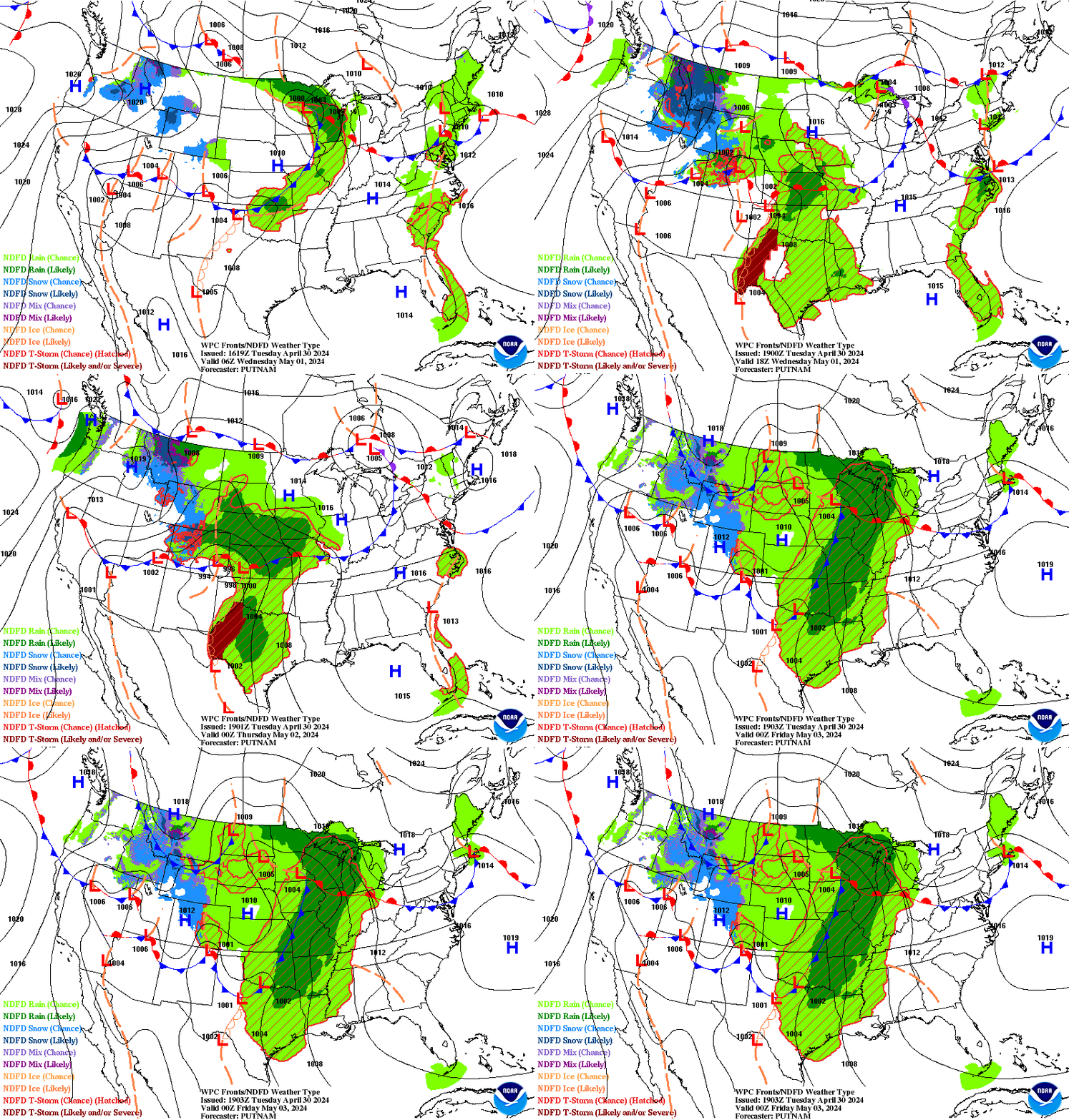
It is difficult to find a more comprehensive Weather Outlook anywhere else with the ability to get a local 10-day Forecast also.
This article focuses on what we are paying attention to in the next 48 to 72 hours. The article also includes weather maps for longer-term U.S. outlooks and a six-day World weather outlook which can be very useful for travelers.

First the NWS Short Range Forecast. The afternoon NWS text update can be found here but it is unlikely to have changed very much. The images in this article automatically update.
Short Range Forecast Discussion
NWS Weather Prediction Center College Park MD
315 AM EST Sun Mar 03 2024Valid 12Z Sun Mar 03 2024 – 12Z Tue Mar 05 2024
…Winter storm in the West producing powerful blizzard in the Sierra
Nevada begins to wane through the day Sunday; more snow expected to begin
Monday……Accumulating snowfall near the Canadian border across Montana and North
Dakota with a wintry mix from North Dakota to northern Minnesota……Another coastal storm is forecast to bring additional rain along the
Mid-Atlantic coast later on Monday...…Much above average, Spring-like temperatures shifting from the
Plains/Midwest into the Northeast as Critical Fire Weather threat persists
in the central/southern High Plains…Conditions in the West which has been impacted by widespread heavy
mountain snows, gusty winds, and a powerful blizzard in the Sierra should
begin to improve by Sunday morning as a moisture plume form the Pacific
weakens and the track of upper-level energies shifts northward. Winds will
wane in intensity, though some additional heavy snowfall is expected
through the day, particularly for the southern Cascades/Sierra, Wasatch,
and central Rockies. However, additional upper-level energies approaching
the West Coast Monday look to quickly bring back increasing precipitation
chances, including heavy snowfall, to the southern Cascades/northern
Sierra, and potentially inland across the northern Great Basin. Timing and
the location of the heaviest amounts remains a bit uncertain at this time,
but another influx of moisture from the Pacific is expected. Rain showers
and thunderstorms will persist along the coast of the Pacific Northwest
and northern California as a surface trough lingers along the coast. Some
locally heavy rainfall may occur Monday as the next system moves in,
particularly along southern Oregon into northern California.Upper-level energy shifting eastward away from the West is helping to
organize/deepen a low pressure/frontal system over the Northern Plains
this morning, which is forecast to track eastward towards the
Midwest/Great Lakes Monday. Moderate to locally heavy snowfall is expected
to the northwest of the surface low track as colder air spreads in from
the north, most likely along the Canadian border from eastern Montana into
western North Dakota. A wintry mix is expected to the east from eastern
North Dakota into northern Minnesota. The deepening low will also bring
some gusty winds, with the potential for blowing snow where snowfall does
occur. To the south and east across the Mississippi Valley/Midwest,
initially limited moisture will keep precipitation chances very low
through Monday morning despite the approaching frontal system. However,
southerly return flow from the Gulf will eventually begin to lead to
increasing shower and thunderstorm chances through the day Monday and
particularly Monday night. Deeper moisture over portions of the central
Gulf Coast into the Lower Mississippi Valley may result in some locally
heavy rainfall and an isolated instance or two of flash flooding. Some
severe thunderstorms producing large hail and damaging winds may also be
possible.Showers will end Sunday morning in New England as a coastal storm departs
the region east into the Atlantic. A quasi-stationary frontal boundary
lingering southwestward along the coast of the Southeast and into Florida
will keep storm chances up there through the day Sunday. Then, on Monday,
another coastal low is expected to organize along the Carolinas and begin
to move northward, bringing additional shower chances into the
Mid-Atlantic through Tuesday morning, especially for coastal areas.Widespread much above average, Spring-like high temperatures will persist
across the central/eastern U.S. Sunday and Monday. The greatest anomalies
of 25-35 degrees will stretch from the Lower/Middle Missouri Valley
northeastward into the Upper Great Lakes Sunday, shifting into the Ohio
Valley, Lower Great Lakes, and interior Northeast on Monday. Numerous
daily record-tying/breaking highs are possible as temperatures reach into
the 70s for most locations. Conditions will also be rather warm across the
central and southern Plains Sunday, with temperatures well into the 70s
and even low to mid-80s. Unfortunately, persistent lee troughing leading
to gusty winds and dry conditions will continue the threat for wildfires
along the central and southern High Plains, with a Critical Risk of Fire
Weather (level 2/3) outlined by the Storm Prediction Center. Along the
East Coast, highs are forecast to range between the 40s and 50s for New
England, 50s and 60s for the Mid-Atlantic, and 70s to low 80s for the
Southeast/Florida. In the West, highs will remain cooler and below
average, ranging from the 30s and 40s in the Pacific Northwest and much of
the Interior West, 50s in northern/central California, 60s in southern
California, and 60s and 70s into the Desert Southwest. The coldest spot in
the country will be in the Northern Rockies/adjacent High Plains, where
highs will be in the teens and 20s following a couple cold front passages.
To get your local forecast plus active alerts and warnings click HERE and enter your city, state or zip code.
Above is a 72 hour animation of the forecast. Learn about wave patterns HERE.
Then, looking at the world and of course, the U.S. shows here also. Today we are looking at precipitation.
Please click on “Read More” below to access the full Daily Report issued today.
| Notices: What would you like to learn about? Please provide that to me via the comment section at the end of the article. |
Now more detail on the 48-Hour Forecast (It is a 48 to 72 Hour Forecast actually)
Daily weather maps. The Day 1 map updates twice a day and the Day 2 and 3 maps update only once a day. These maps update automatically. But if that does not happen, you can get updates by clicking HERE
TODAY (or late in the day the evening/overnight map will appear) (Key to surface fronts shown on maps and you will then also be able to insert a city name or zip code and get a local NWS forecast).
TOMORROW
NEXT DAY
This animation shows how things may play out over the next 60 hours. To update click here.
The NWS Climate Prediction Center’s: Watches, Warnings, and Advisories plus other information can be found HERE. We post at least one of those updates daily, sometimes both. The Highlights are shown in the lede paragraph of this article.
ATMOSPHERIC RIVERS
This tells us what is approaching the West Coast. Click HERE to update If I have not gotten around to doing the update. Here is some useful information about Atmospheric Rivers.
Below is the current five-day cumulative forecast of precipitation (Updates can be found HERE)
Ski SnowReports
New Feature – Ski Reports. It is difficult to find reports that auto-update on-screen (and they are very long) but these links will get you to them – If you have additional suggestions make them in the comments section after every Econcurrents Article and we may add those links. We will try to not have too much overlap as that can add to the confusion.
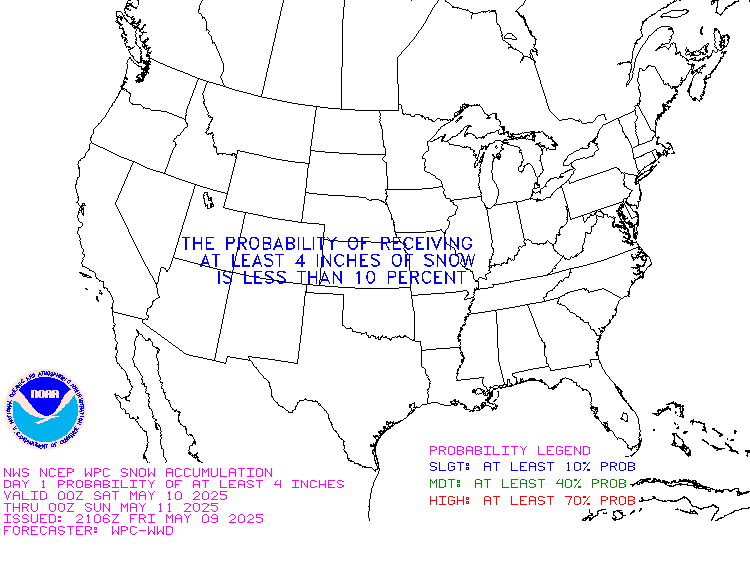
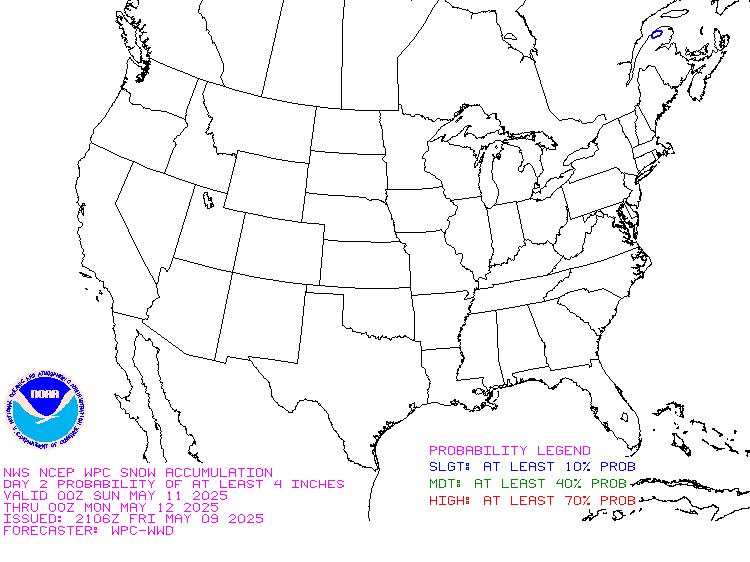
Snow Forecasts. And remember this shows natural snow. Ski resorts also make their own snow.
Day 1
Day 2
Additional snow information can be found here, here, here, and here. The second link provides animations.
Now we look at Intermediate-Term “Outlook” maps for three time periods. Days 6 – 10, Days 8 – 14, and Weeks 3 and 4. An outlook differs from a forecast based on how NOAA uses these terms in that an “outlook” presents information as deviation from normal and the likelihood of these deviations.
Below are the links to obtain updates and additional information. They are particularly useful if you happen to be reading this article significantly later than when it was published. I always try to provide readers with the source of the information in my articles. These links may also be useful for those viewing this article on a cell phone or other small screen.
| Days 6 – 10 (shown in Row 1) | Days 8 – 14 (Shown in Row 2) | Weeks 3 and 4 (Shown in Row 3 but updates only on Fridays) |
| https://www.cpc.ncep.noaa. gov/products/predictions/610day/ | https://www.cpc.ncep .noaa.gov/products/predictions/814day/ | https://www.cpc.ncep.noaa.gov/products/predictions/WK34/ |
Showing the actual maps. They should now update automatically. The Week 3 – 4 Outlook only updates on Fridays. So below is what I call the Intermediate-term outlook. On Fridays, it extends out 28 Days. That declines day by day so on Thursday it only looks out 22 days until the next day when the Week 3 – 4 Outlook is updated and this extends the outlook by one additional week.
| 6–
10
|
|
|
| 8–
14 |
|
|
| 3–
4 |
|
|
HAZARDS OUTLOOKS
Click here for the latest complete Day 3 -7 Hazards forecast which updates only on weekdays. Once a week probably Monday or Tuesday I will update the images. I provided the link for readers to get daily updates on weekdays. Use your own judgment to decide if you need to update these images. I update almost all the images Friday Night for the weekend edition of this Weather Report. So normally readers do not need to update these images but if the weather is changing quickly you may want to.
Temperature month to date can be found at https://hprcc.unl.edu/products/maps/acis/MonthTDeptUS.png
Precipitation month to date can be found at https://hprcc.unl.edu/products/maps/acis /MonthPNormUS.png
World Forecast [that website is has been intermittent so be patient]
Below are the Day 1 -3 and 4-6 forecasts for temperature and precipitation. Updates and much additional information can be obtained HERE
World Temperature Anomalies
World Accumulated Precipitation
This information is provided by the University of Maine. They draw upon many different sources. There is a lot of information available at the link provided. I have just provided two useful forecasts. There are probably over a hundred different forecasts available from this source.
Worldwide Tropical Forecast (This is a NOAA Product)
This graphic updates on Tuesdays) If it has not been updated, you can get the update by clicking here Readers will only have to do that if they are reading this article much later than the date of it being published.
Information on Tropical Storms can be found HERE. Western Pacific information can be found HERE.
–
| I hope you found this article interesting and useful. |
–