At the end of every month, NOAA updates its Outlook for the following month which in this case is January of 2024. We are reporting on that tonight.
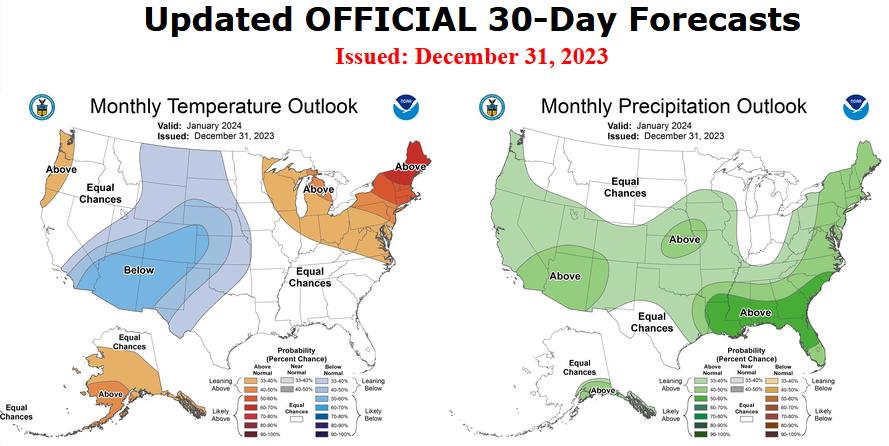
There have been some very significant changes in the Outlook for January and these are addressed in the NOAA Discussion so it is well worth reading. We provided the prior Mid-Month Outlook for January for comparison. It is easy to see the changes by comparing the Mid-Month and Updated Maps.
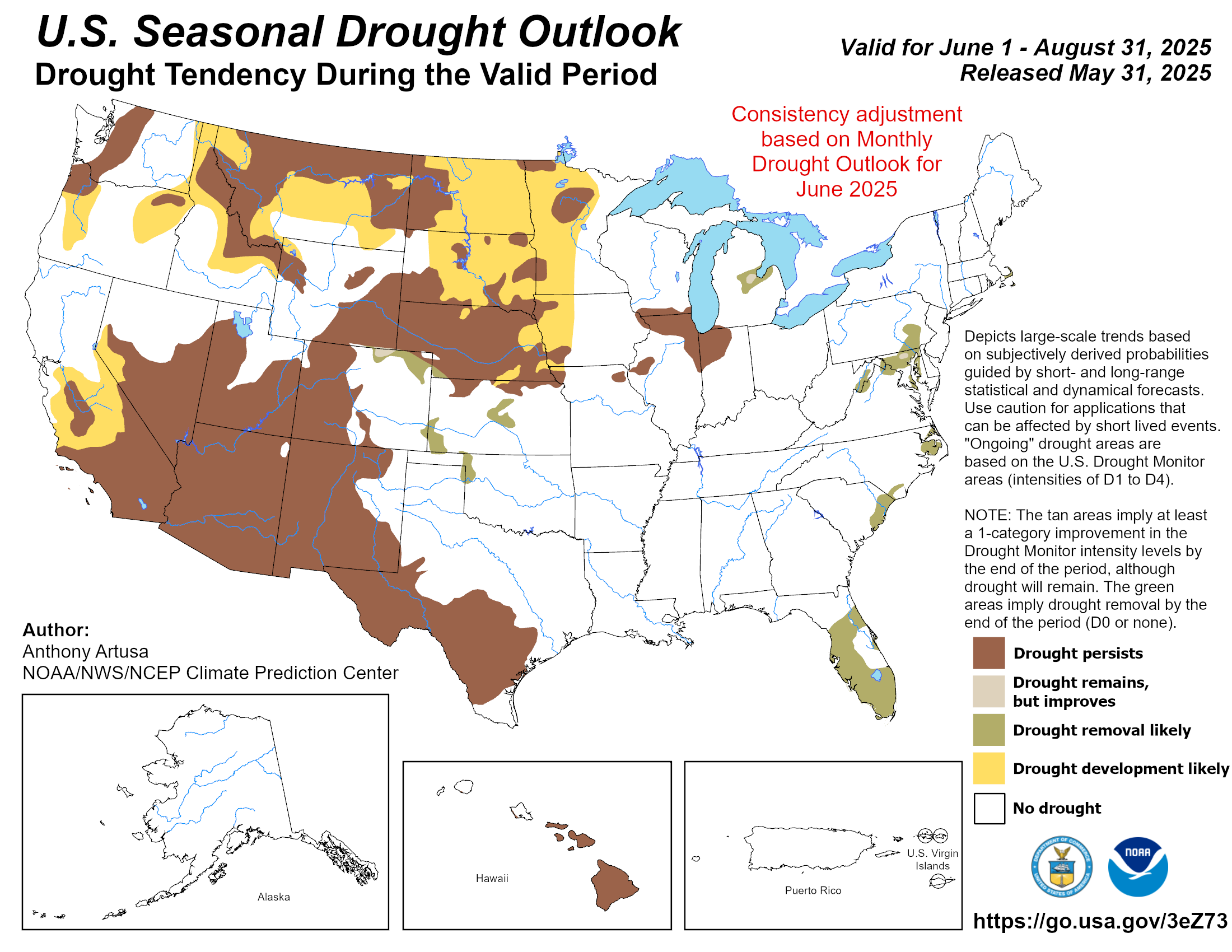
The article includes the Drought Outlook for January. NOAA also adjusted the previously issued Seasonal Drought Outlook to reflect the changes in the January Drought Outlook.
The best way to understand the updated outlook for January is to view the maps and read the NOAA discussion. I have highlighted the key statements in the NOAA Discussion.
Here is the updated Outlook for January 2024
For Comparison Purposes, Here is the Mid-Month Outlook for January.
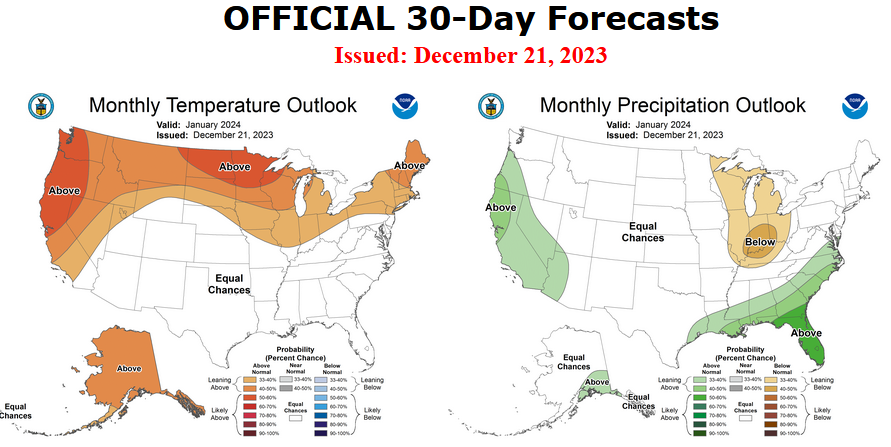
| There have been some significant changes. Remember, it is the top set of maps that are the current outlook for December. Until now we were not sure that NOAA (actually their CPC Divison) had moved the storm track sufficiently south given the strength of this El Nino as measured by the Nino 3.4 Index. All of a sudden they have. |
|
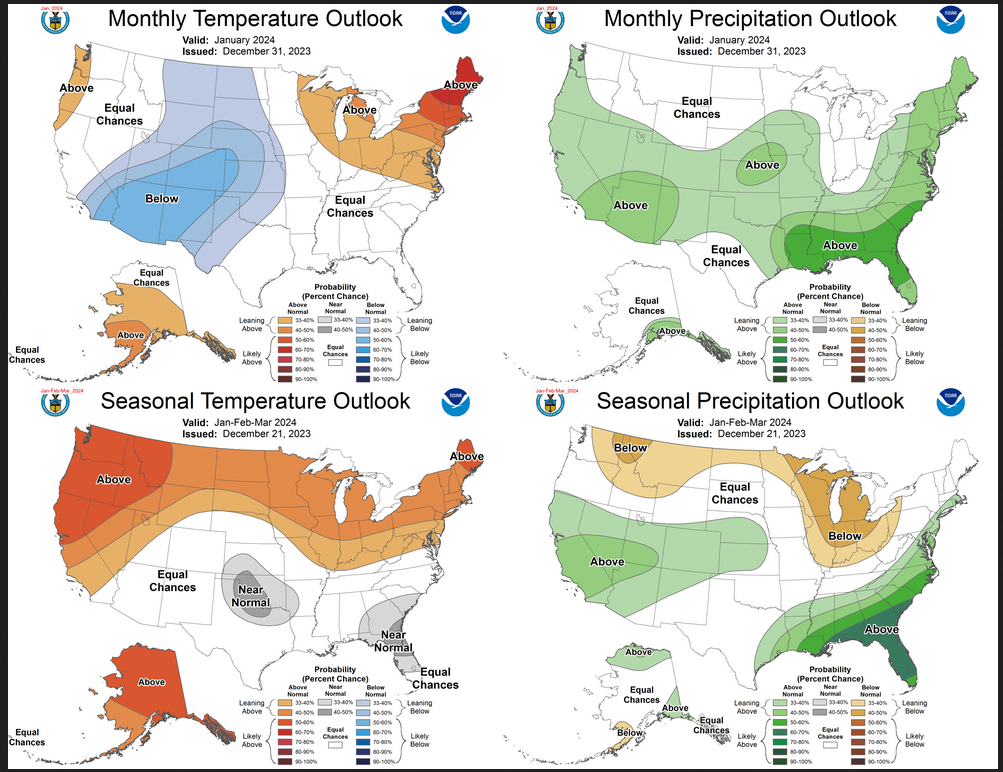
The top row is the Updated Outlook for the new month. There is a temperature map and a precipitation map. The second row is a three-month outlook that includes the new month. I think the outlook maps are self-explanatory. What is important to remember is that they show deviations from the current definition of normal which is the period 1991 through 2020. So this is not a forecast of the absolute value of temperature or precipitation but the change from what is defined as normal or to use the technical term climatology. The three-month map was issued on December 21, 2023. Is it still valid?
|
Some readers may need to click “Read More” to read the rest of the article. Some will feel that they have enough information. But there is a lot more information in the rest of this article.
| Our regular Daily Weather article can be found HERE. In addition to the short-term forecast it also provides the 6 – 10 day, 8 – 14 day, and Week 3 – 4 Outlooks. That is not a full month but close to it. So it is helpful if one wants to understand how the full-month forecast is expected to vary through the month. And the maps in the Daily Article update throughout the month. |
Here are larger versions of the Temperature and Precipitation Outlook maps.
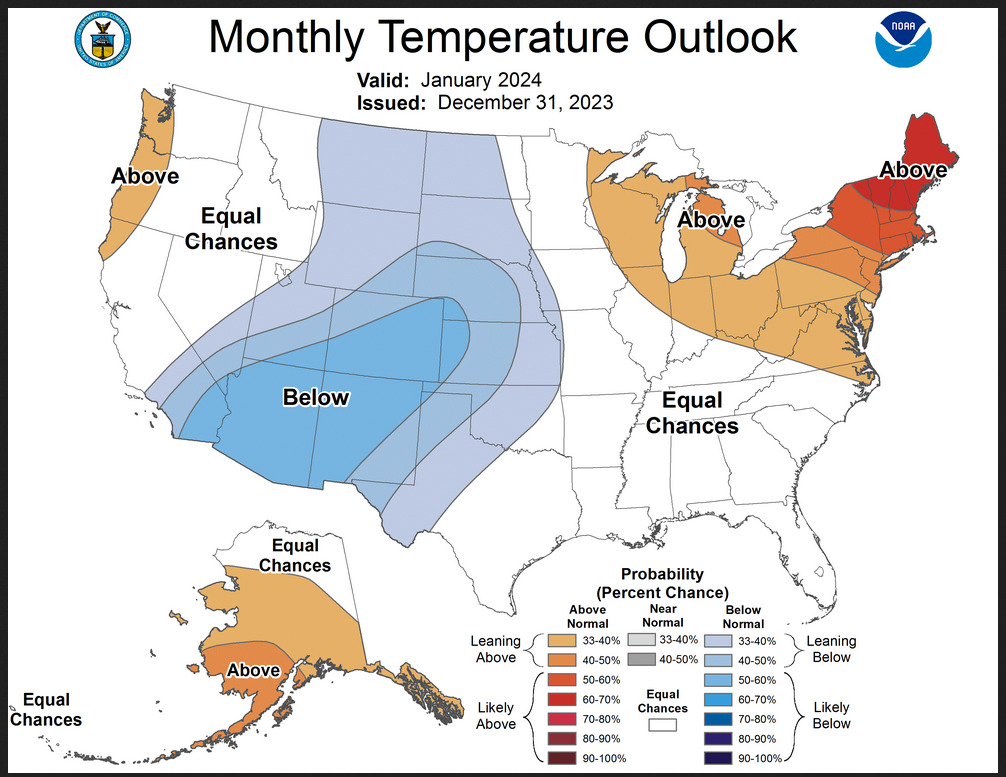
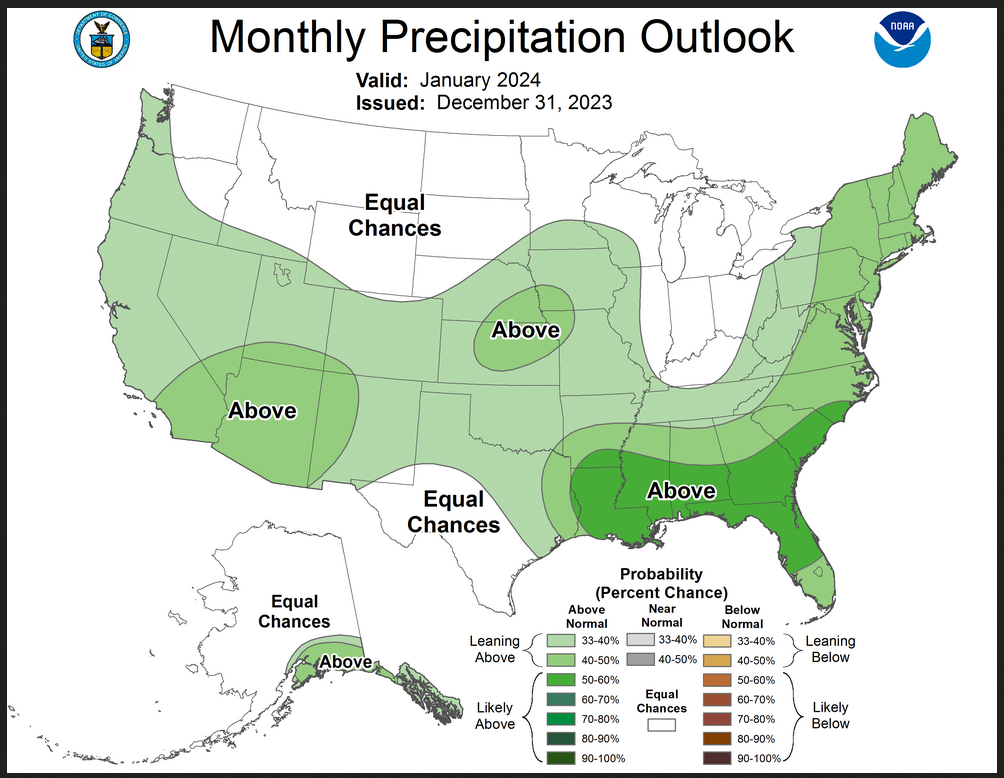
NOAA (Really the National Weather Service Climate Prediction Division CPC) Discussion. I have shown certain important points in bold type. My comments if any are in brackets [ ].
30-DAY OUTLOOK DISCUSSION FOR JANUARY 2024
The updated monthly temperature and precipitation outlooks for January 2024 are based on the latest dynamical models , WPC temperature and precipitation forecasts during the first week of the month, the CPC 6-10/8-14 day temperature and precipitation outlooks, and the week 3-4 outlook (valid January 13-26). El Niño remains a major climate driver and is expected to be one of the influences on the mid-latitude circulation pattern and associated January temperature and precipitation. Since late November, the Madden-Julian Oscillation (MJO) has completed a circumnavigation of the global tropics with its enhanced phase recently propagating east to Africa. The evolving longwave pattern with a high amplitude trough developing over the western contiguous U.S. (CONUS) during early January is consistent with MJO forcing. Lagged composites, based on phase 2 of the Real-time Multivariate MJO index, were considered and would favor below (above)-normal temperatures across the southwestern (eastern) CONUS for much of the month. A negative Arctic Oscillation (AO) is predicted through at least mid-January and the high-latitude blocking is likely to result in a week or more of below-normal temperatures across much of the western and central CONUS. The longevity of a full-latitude 500-hPa ridge over Alaska would dictate the duration of this anomalous cold, especially for the Great Plains.
The GEFS, ECMWF, and Canadian ensemble means remain consistent and in good agreement that a highly amplified 500-hPa trough shifts east to the Rockies and Great Plains during early January. This leads to a wetter revised precipitation outlook throughout the CONUS with enhanced above-normal precipitation probabilities expanded to include the Southwest, Great Basin, Central to Southern Rockies, and parts of the Great Plains. The January outlook continues to lean wet along the West Coast, but probabilities are modest given uncertainty on the primary storm track. Above-normal precipitation is slightly favored for parts of the drier climatological areas of the Midwest where there are increased chances of one or more low pressure systems to track northeast through this region by mid-January. Although the first week of January is expected to be mostly dry across the Great Lakes and Ohio Valley, the favored dryness in the initial January outlook (released December 21) was changed to equal chances (EC) for below, near, and above-normal precipitation due to the amplified 500-hpa trough and the 8-14 day outlook leaning wet. El Niño continues to strongly favor above-normal precipitation across the Southeast and much of the Gulf Coast. Enhanced above-normal precipitation probabilities are forecast throughout the eastern and much of the south-central CONUS due to a wet signal in the 8-14 day and week 3-4 tools. Above-normal precipitation probabilities are raised to 50-60 percent across the Lower Mississippi Valley based on 1 to 3 inches of precipitation forecast during the first week of January and a continued wet signal into the latter half of the month. El Niño composites along with week-2 and week 3-4 outlooks support increased above-normal precipitation probabilities for southeastern Alaska.
The highest forecast confidence in the revised monthly outlook exists for New England where above-normal temperatures are likely given the consistent signal for above-normal temperatures each week throughout the month and sparse snow cover heading into January. Month-to-date (December 1 to 30) temperatures have averaged above-normal throughout the CONUS with the largest anomalies (more than +9 degrees F) observed across the northern Great Plains and Upper Mississippi Valley. With a negative AO likely to persist through at least mid-January and a high-amplitude trough predicted to become established over the West and Great Plains, there are signs for a much colder outcome for the January mean temperature for parts of the lower 48 states. Increased below-normal temperature probabilities extend from southern California and the Southwest east to the Great Plains where below-normal temperatures are likely to accompany the amplified 500-hPa trough and model solutions are depicting Arctic high pressure shifting south from Canada during the second week of January. A CPC tool that uses a period-weighted method of temperature forecasts throughout the month flipped today towards below-normal temperatures across the Great Plains and supports the revised monthly outlook. Despite the model trend towards anomalous cold across the northern Great Plains by mid-month, probabilities are tempered due to above-normal temperatures to start the month and the week 3-4 tools indicating that temperatures could moderate during late January. Above-normal temperatures are slightly favored for parts of northern California and the coastal Pacific Northwest based on forecasts at the beginning of the month and week 3-4. El Niño composites favor above-normal temperatures throughout Alaska but EC is forecast for northern parts of the state due to the proximity of Arctic high pressure nearby during early to mid-January.
Drought Outlook
Here is the newly issued Drought Outlook for the month.
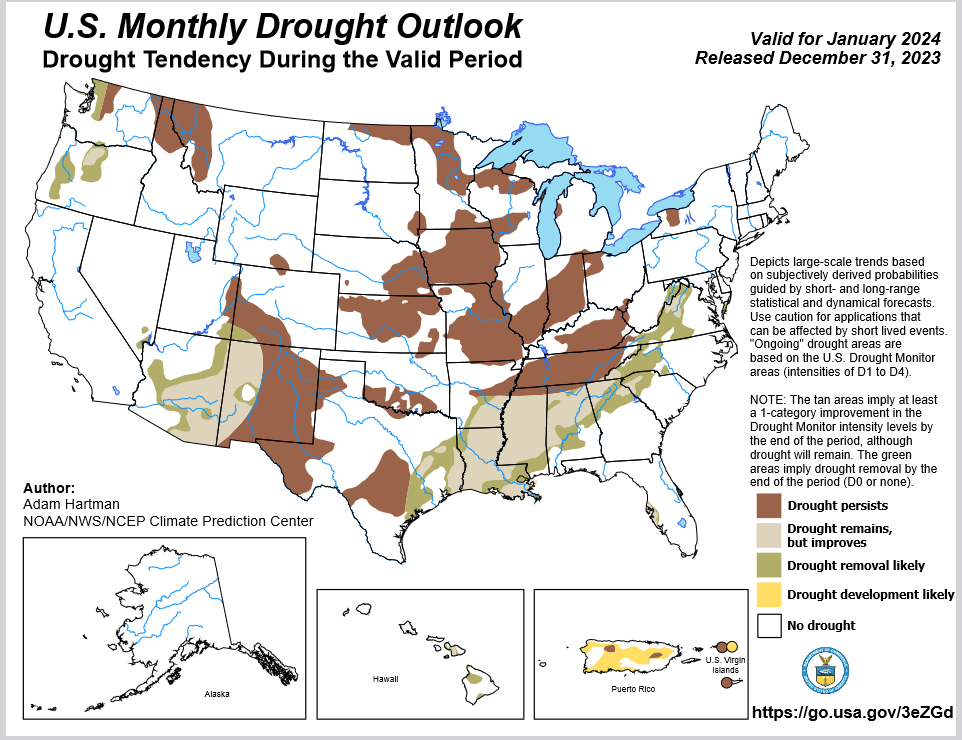
| You can see where drought development or reduction is likely. Overall the forecast is for a reduction of drought conditions. The summary and detailed discussions that accompany this graphic can be accessed HERE, but the short version is shown below. |
Here is the short version of the drought summary
Latest Monthly Assessment – Since the December Monthly Drought Outlook (MDO) released on November 30, 2023, drought has slowly improved across parts of the Pacific Northwest, the Central Gulf Coast, and parts of the southeastern contiguous U.S. (CONUS). Conversely, drought development and intensification was most prominent across parts of the northern Intermountain West and Middle Mississippi and Ohio Valleys. The Great Plains and Upper Midwest remain a battleground of sorts, with mixed areas of improving and degrading conditions, based on where the heaviest precipitation fell or did not fall, respectively. Looking forward through the end of January, slow improvements are forecast to continue across parts of the Pacific Northwest, given the wet time of year and favorable precipitation and temperature outlooks through at least the first half of the month. However, much of the moisture is not likely to make it far enough inland to meaningfully impact ongoing drought in the interior Pacific Northwest and northern Intermountain West, where drought is favored to persist. Ongoing drought conditions, the result of a below average summer monsoon season, is forecast to ease a bit in locations where precipitation chances are highest, especially through the first half of January. However, improvements are likely to be targeted in nature. The Great Plains will likely remain a battleground, with mixed degradations and improvement. However, improvements are most likely in eastern Texas, with persistence favored elsewhere in the Plains states. An active storm track is forecast to continue across the southern tier of the CONUS, favoring improving drought conditions across the Gulf Coast states and extending northward into the Central Appalachians. A cold time of year and favorable precipitation signals through the middle of January make drought persistence the most likely outcome across the Midwest, as short-term rainfall may not be enough to overcome long-term precipitation deficits.
Alaska is forecast to remain drought-free through the end of January, with wet antecedent conditions and favorable precipitation outlooks for much of the state throughout the month. Drought improvement is favored in Hawaii, following a wet December in conjunction with favorable precipitation outlooks through mid-January. Conversely, antecedent dryness, El Niño, and unfavorable precipitation and temperature outlooks favor drought persistence and development in Puerto Rico and the U.S. Virgin Islands.
We also have an updated Seasonal Drought Outlook (link).
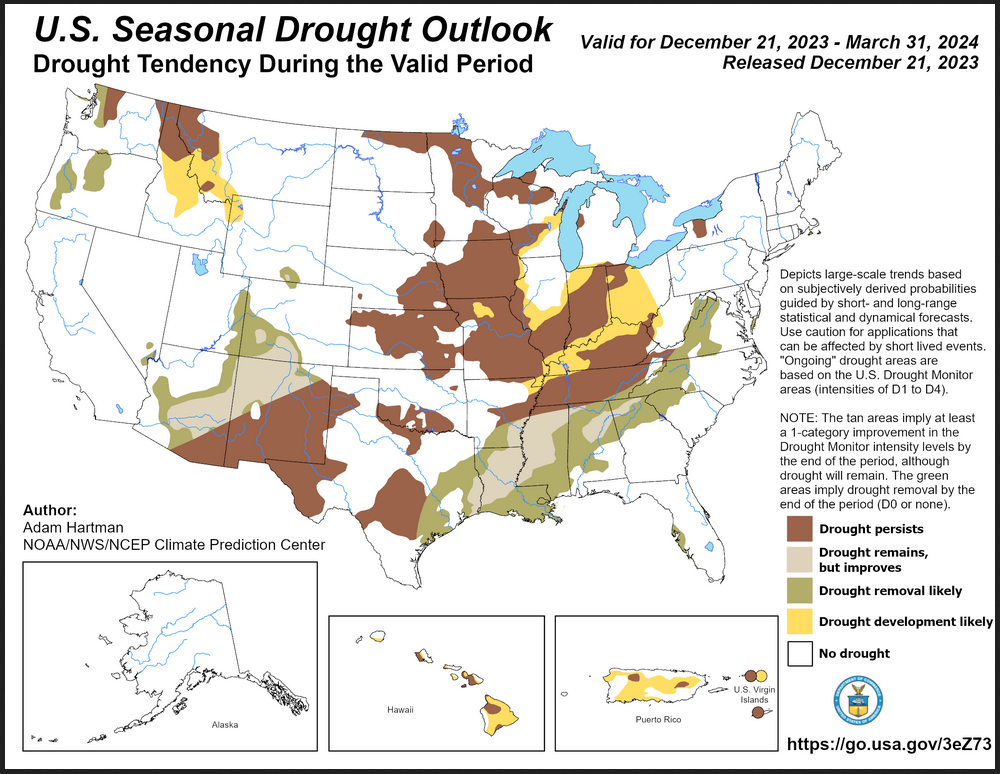
| It is this month a bit different than the single-month outlook and it covers a longer period of time. It does show significant improvement over current conditions. |
| I hope you found this article interesting and useful |

Thanks for a concise report and for highlighting the updates.
Looks like the first Winter Storm Warming has been issued for this area (Gloerieta Pass in particular). I hope everyone stays safe.