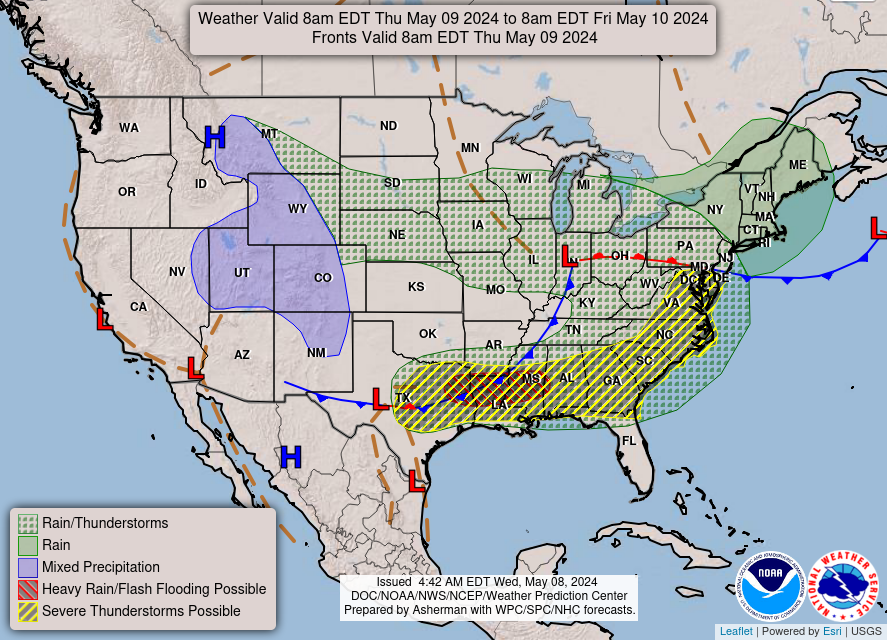
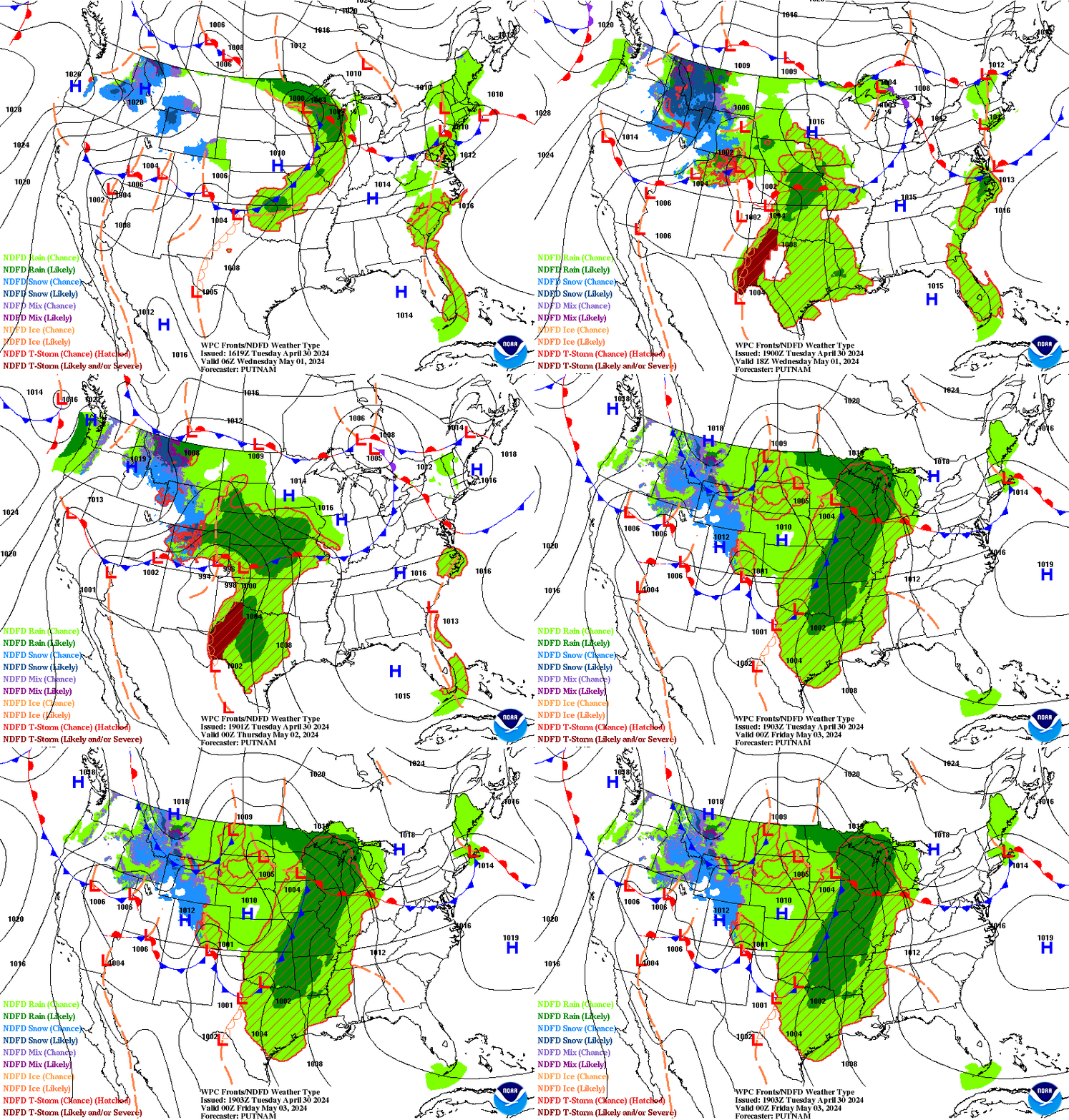
Here is what we are paying attention to this evening and the next 48 hours from this evening’s NWS Forecast.
...There is a Moderate Risk of excessive rainfall over parts of the Upper
Great Lakes and Upper/Middle Mississippi Valley through Monday morning...

...There is a Slight Risk of excessive rainfall over parts of Northern New
England and Central/Southern Rockies from Monday into Tuesday morning...

...Dangerous heat across parts of the Pacific Northwest, Middle
Mississippi Valley, Central Plains, and Northeast Coast...

Continuation of the NWS Short Range Forecast (It is updated twice a day and these updates can be found here.
A quasi-stationary front extending from the Northeast to the Great Lakes,
then roughly southwestward to the Central High Plains, will slowly move to
Southern New England to the Ohio Valley and the Southern Plains by Tuesday.

Moisture pooling along the front will aid in producing showers and
thunderstorms over parts of the Great Lakes/Upper Mississippi Valley to
the Central High Plains that will move eastward with the front through
Tuesday. Some of the storms will produce heavy rain. Therefore, The WPC
has issued a Moderate Risk of excessive rainfall with these thunderstorms
over parts of the Upper Great Lakes and Upper/Middle Mississippi Valley
through Monday morning. The associated heavy rain will create numerous
areas of flash flooding. Furthermore, many streams may flood, potentially
affecting larger rivers.

Furthermore, monsoonal moisture will trigger diurnal showers and
thunderstorms with heavy rain over parts of the Southwest and the
Central/Southern Rockies on Sunday. Therefore, the WPC has issued a Slight
Risk of excessive rainfall over parts of the Southwest and parts of the
Central/Southern Rockies and Central High Plains through Monday morning.
The associated heavy rain will create mainly localized areas of flash
flooding, with urban areas, roads, and small streams the most vulnerable.

On Monday, the front will extend into the Northeast, producing showers and
thunderstorms with heavy rain over parts of the region. Therefore, the WPC
has issued a Slight Risk of excessive rainfall with these thunderstorms
over parts of Northern New England from Monday into Tuesday morning. The
associated heavy rain will create mainly localized areas of flash
flooding, with urban areas, roads, and small streams the most vulnerable.
The excessive rainfall threat decreases to a Marginal Risk on Tuesday from
the Northeast to the Middle/Lower Mississippi Valley.

In addition, monsoonal moisture will continue to trigger diurnal showers
and thunderstorms with heavy rain over parts of the Central/Southern
Rockies on Monday. Therefore, the WPC has issued a Slight Risk of
excessive rainfall over parts of the Central/Southern Rockies from Monday
into Tuesday morning. The associated heavy rain will create mainly
localized areas of flash flooding, with urban areas, roads, and small
streams the most vulnerable.

On Tuesday, the threat of excessive rainfall will move southwestward over
parts of the Southwest and Great Basin. Therefore, on Tuesday, the WPC has
issued a Slight Risk of excessive rainfall over parts of the Southwest/
Great Basin and Southeastern California. The associated heavy rain will
create mainly localized areas of flash flooding, with urban areas, roads,
and small streams the most vulnerable.

Meanwhile, a weakening upper-level high over the Central Plains and Middle
Mississippi Valley will aid in allowing temperatures to reach into the
upper nineties to low hundreds over the region and along with high
humidity, have prompted Heat Advisories over parts of the Middle
Mississippi Valley and Central Plains through Sunday evening. Furthermore,
weak ridging over the Northeast will allow temperatures to rise into the
low to mid-nineties and dew points in the upper sixties to low seventies
have prompted Heat Advisories over parts of the Northeast Coast to parts
of Lake Ontario through Sunday evening, too.

However, upper-level ridging will increase over the Pacific Northwest on
Monday. The ridging will allow the temperature to rise into the
mid-nineties to mid-hundreds prompting Excessive heat warnings and Heat
Advisories to start from noon local time on Monday into late on Tuesday.
Maps that relate the forecast to geography can be found by clicking Here for Day 1 and Here for Day 2.
Here is a 60-hour animated forecast map that shows how the short-term forecast is expected to play out.
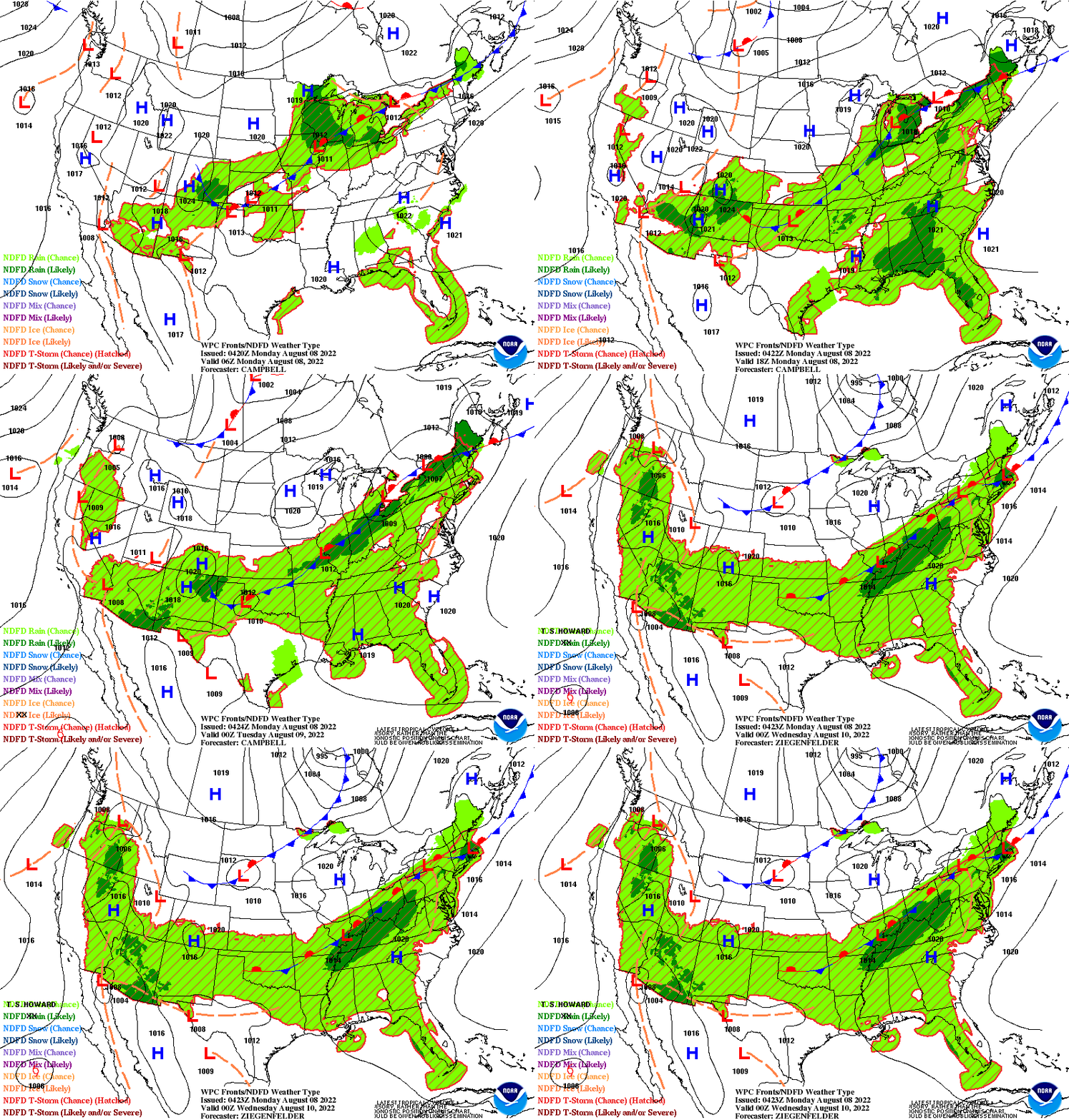
If it needs to be updated click here.
HAZARDS OUTLOOKS
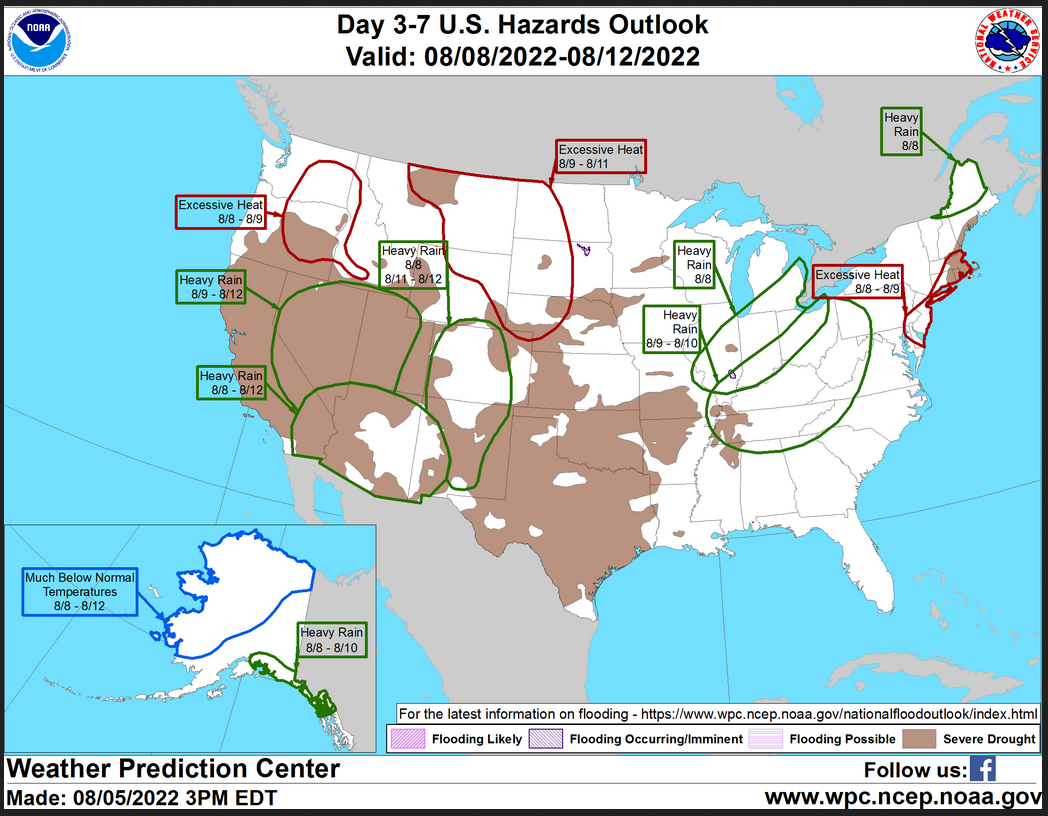
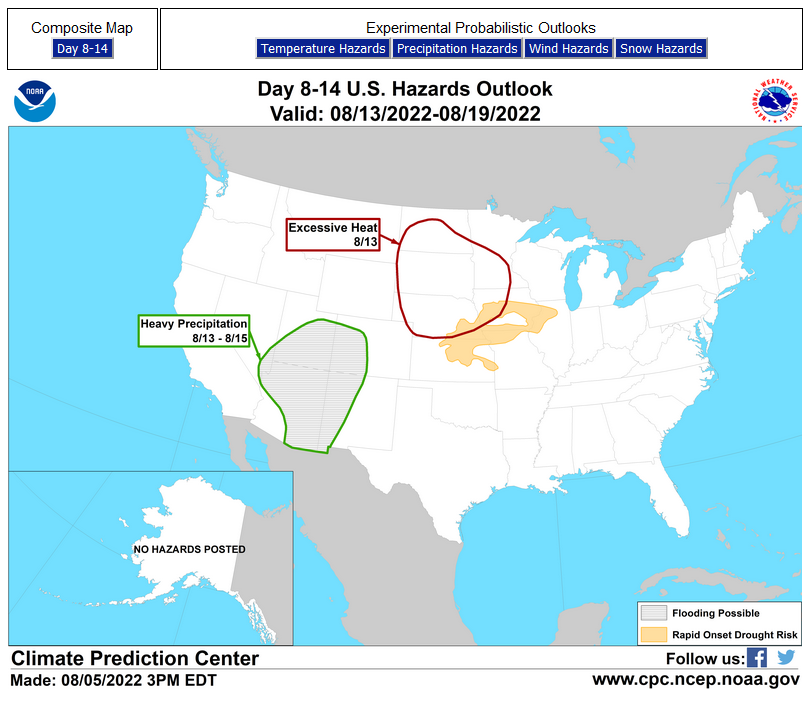
Click h ere for the latest complete Day 3 -7 Hazards forecast which updates only on weekdays. Once a week probably Monday or Tuesday I will update the images. I provided the link for readers to get daily updates on weekdays. Use your own judgment to decide if you need to update these images.
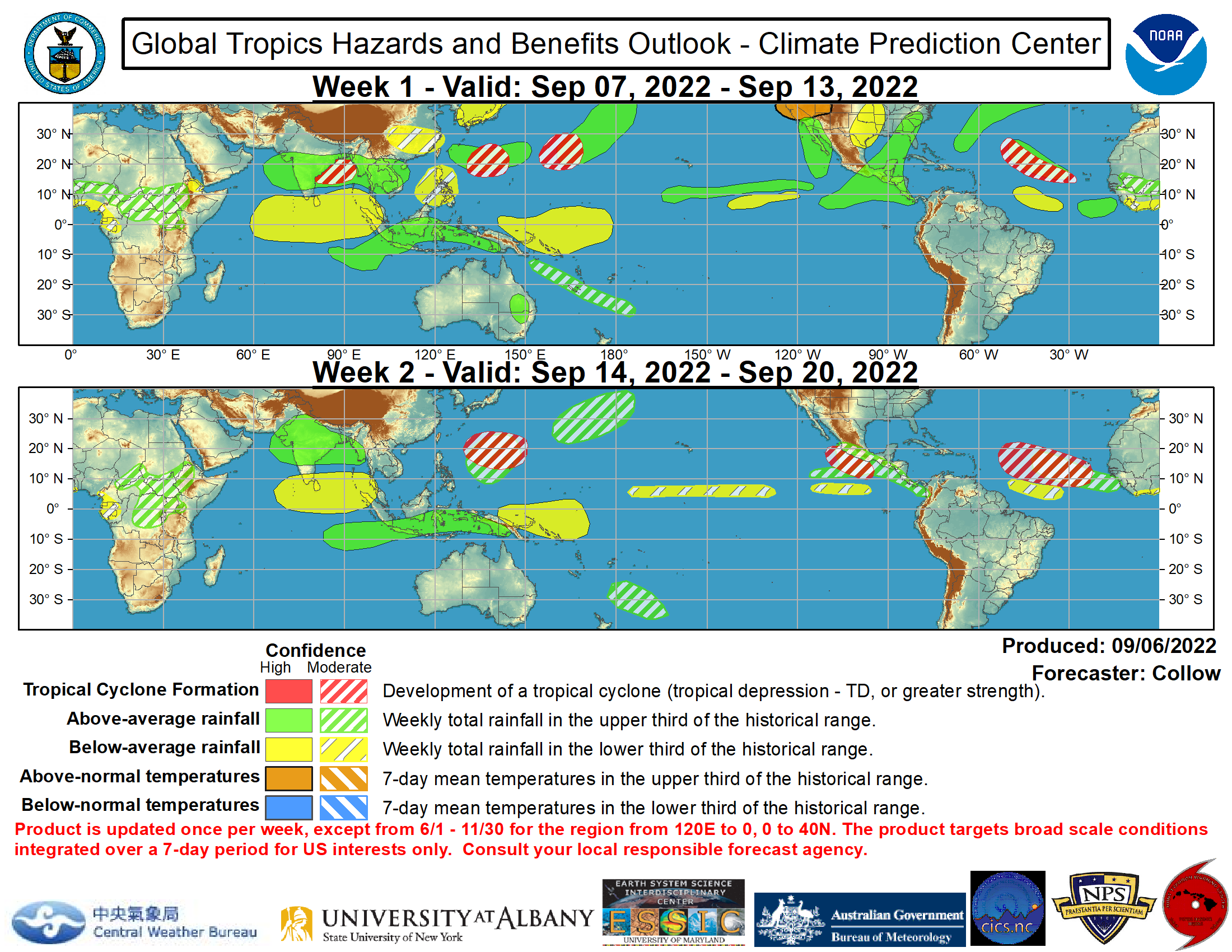
Worldwide Tropical Forecast
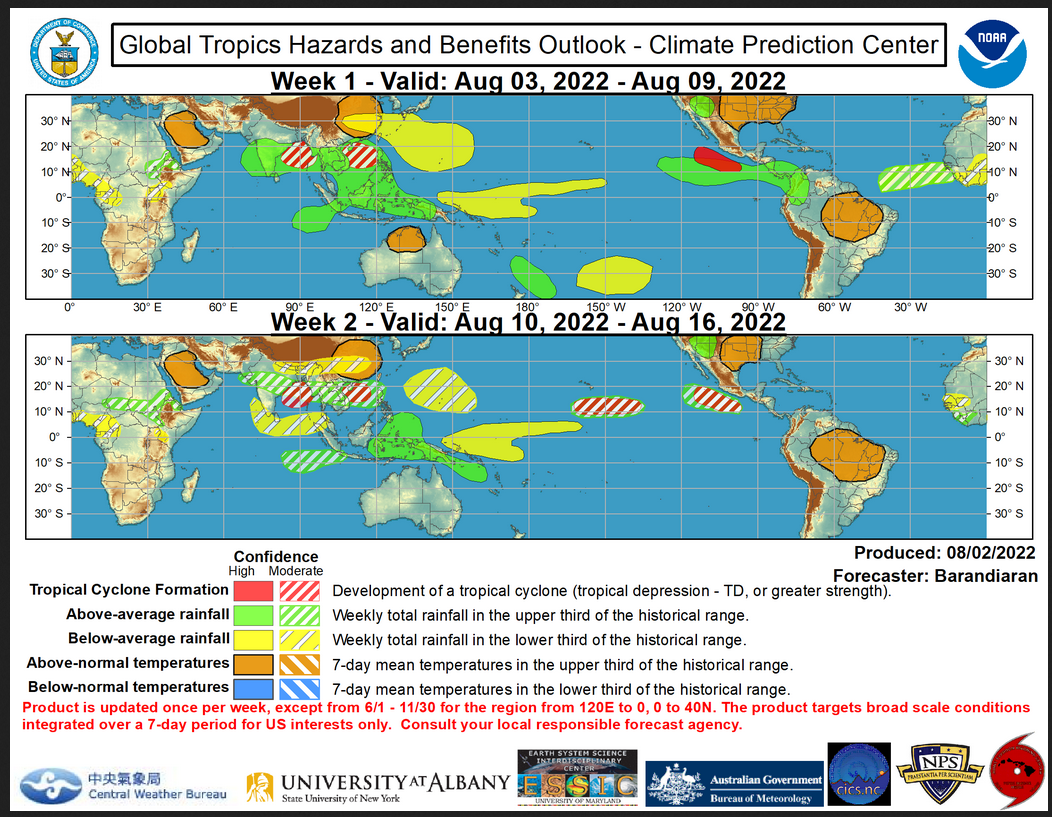
(This graphic updates on Tuesdays) If it has not been updated, you can get the update by clicking here
Detailed Maps and Reports for the Western Atlantic and the Pacific Oceans
Below are three maps that summarize the situation for the Atlantic, Eastern and Central Pacific. Additional information can be accessed by clicking HERE
First the Atlantic
Click to view the forecast map and have access to additional information https://www.nhc.noaa.gov/gtwo.php?basin=atlc&fdays=5
Then Eastern Pacific
Click to view the forecast map and have access to additional information https://www.nhc.noaa.gov/gtwo.php?basin=epac&fdays=5
Then Central Pacific
Click to view the forecast map and have access to additional information https://www.nhc.noaa.gov/gtwo.php?basin=cpac&fdays=5
And the Western Pacific
Click to view the forecast map and have access to additional information https://www.metoc.navy.mil/jtwc/jtwc.html
Some Intermediate-Term Outlooks
Links to “Outlook” maps and discussions for three time periods. Days 6 – 10, Days 8 – 14, and Weeks 3 and 4. An outlook differs from a forecast based on how NOAA uses these terms in that an “outlook” presents information from deviation from normal and the likelihood of these deviations.
You have to click on the links because they do not update automatically and I do not want to have stale images in the article. But it is not difficult to click on a link and you get a large image plus a discussion. On Fridays in a separate article, we will show the images and provide a link in this article that article. But remember what you will see is the images as of Friday. But here you can get the current images simply by clicking on them. Then hit the return arrow at the upper left of your screen to return to the article. You will not find this information easily anywhere else.

Right now you can find these maps here (We show them every Friday there but you can click above and find them).
World Forecast for Day 6 (Currently Set for Day 6 but the reader can change that)
World Weather Forecast produced by the Australian Bureau of Meteorology. Unfortunately, I do not know how to extract the control panel and embed it into my report so that you could use the tool within my report. But if you visit it Click Here and you will be able to use the tool to view temperature or many other things for THE WORLD. It can forecast out for a week. Pretty cool. Return to this report by using the “Back Arrow” usually found top left corner of your screen to the left of the URL Box. It may require hitting it a few times depending on how deep you are into the BOM tool. Below are the current worldwide precipitation and air pressure forecasts for six days out. They will not auto-update and right now are current for Day 6. If you want the forecast for a different day Click Here I will try to update this map each day but you have the link so you can access the dashboard and get a wide variety of forecasts.
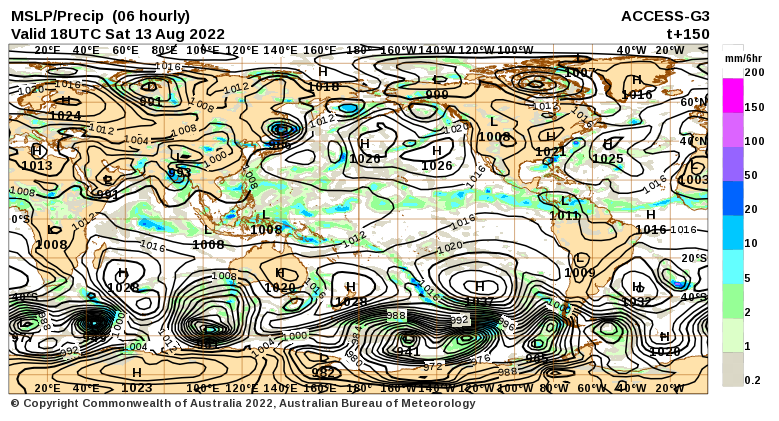
I mostly rely on the reader to interpret world maps. For this map, areas of expected precipitation for the date and time shown are clearly shown.
The number of High-Pressure systems shown is called the Wave Number. Maybe I will discuss WN someday. But it shows how many Rossby Waves there are around the World. Sometimes they are hard to count. Counting Low-Pressure systems should provide the same WN. Rossby Waves are the way the temperature distribution of the Planet remains in balance. It is basically the science of fluid dynamics. It can be very helpful in predicting the movement of weather patterns.
Month to Date Information
Month to date Temperature can be found at https://hprcc.unl.edu/products/maps/acis/MonthTDeptUS.png
Month to date Precipitation can be found at https://hprcc.unl.edu/products/maps/acis/MonthPNormUS.png