Updated at 5:27 p.m. June 7, 2023
Here is what we are paying attention to in the next 48 to 72 hours. The article also includes weather maps for longer-term outlooks and a five-day World weather forecast.
We start with the U.S. Information.
Short Range Forecast Discussion
NWS Weather Prediction Center College Park MD
333 PM EDT Wed Jun 07 2023Valid 00Z Thu Jun 08 2023 – 00Z Sat Jun 10 2023
…Hazardous air quality levels will persist across the Northeast and
Mid-Atlantic through Thursday before shifting westward into Ohio Valley on
Friday……Heavy rainfall possible throughout central and northern Rockies on
Wednesday; rainfall threat will shift northward into Montana on Thursday
and Friday……Below-average temperatures to continue in the East and Southwest, while
Pacific Northwest and Plains stay above-average.

| Information Note: This article is now set up so that all the maps should automatically update. The links are provided but should not be needed. The downside is that if you go back to a previous version the maps will have been updated and not be relevant to the date of the prior article but will be current information. The NWS twice-a-day 48-hour forecasts do not auto-update in this article. I do it and I can be late doing it. The link for the NWS updates is HERE. Most of our other articles will not be set up to auto-update so that prior versions of the article will be meaningful.
Recently, we published the Weather Update for June. You can access it HERE. We also published the Weekly Crop Report. It can be accessed HERE. Remember the easiest way to get back to the article you were reading is to hit the return arrow in the upper left of your screen. There are other ways. |
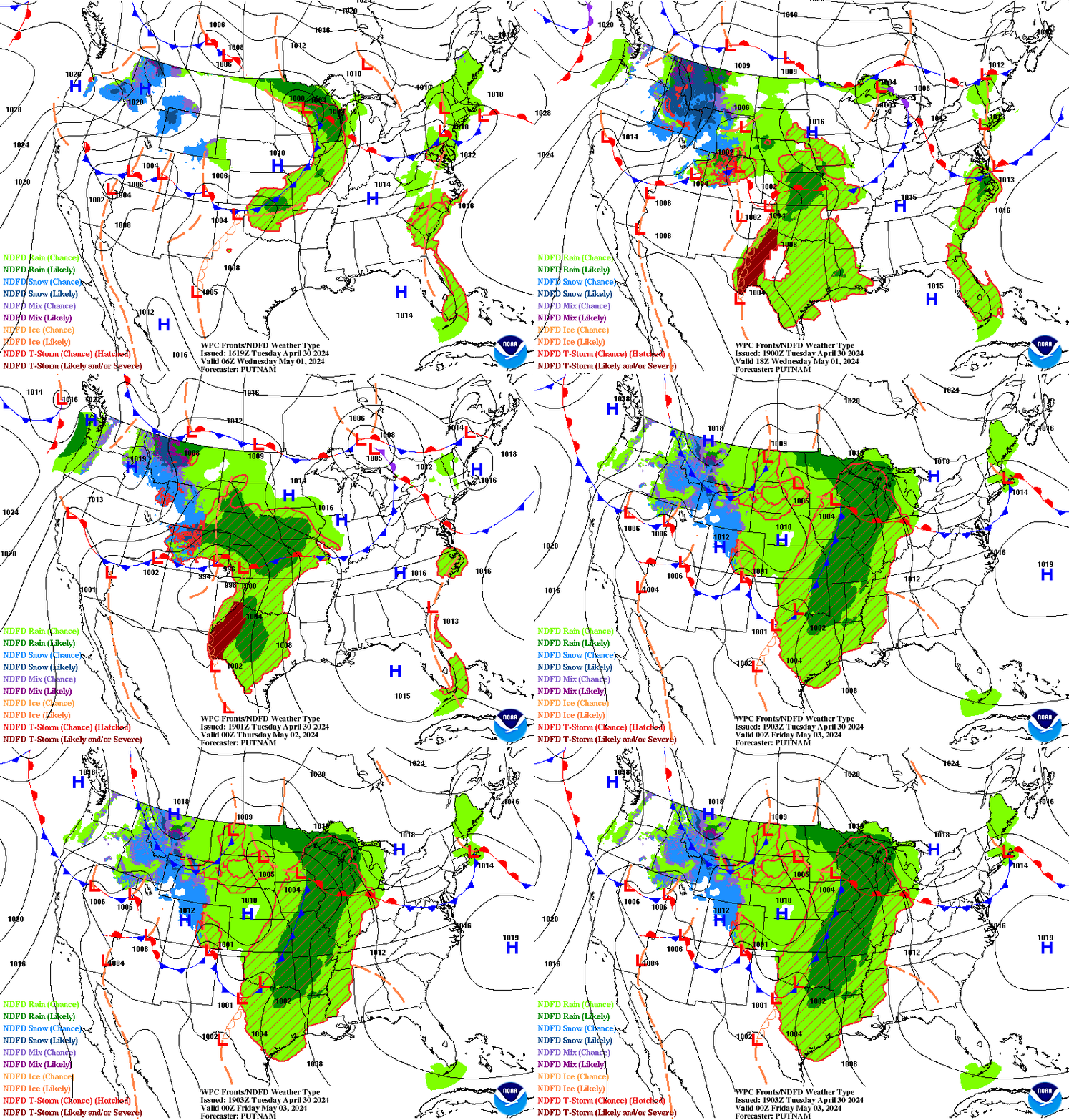
First, the 48-Hour Forecast (It is a 48 to 72 Hour Forecast actually)
Daily weather maps. The Day 1 map updates twice a day and the Day 2 and 3 maps update only once a day. These maps update automatically. But if that does not happen, you can get updates by clicking HERE
TODAY (or late in the day the evening/overnight map will appear)
TOMORROW
NEXT DAY
This animation shows how things may play out over the next 60 hours. To update click here.
The NWS Climate Prediction Center’s: Watches, Warnings, and Advisories plus other information can be found HERE.
ATMOSPHERIC RIVERS
This tells us what is approaching the West Coast. Click HERE to update If I have not gotten around to doing the update. Here is some useful information about Atmospheric Rivers.
Continuation of the NWS Short Range Forecast. It is updated by NWS twice a day and these updates can be found here. We post at least one of those updates daily, sometimes both. The Highlights are shown in the lede paragraph of this article.
Hazardous air quality and widespread smoky conditions will persist through
Wednesday afternoon and evening throughout the Northeast and Mid-Atlantic
as smoke associated with wildfires in Canada continues to push southward
into the lower 48. As a nearly stationary upper-low churns off the New
England coastline, sustained northerly winds will allow the smoke to
spread southward, with major metro areas such as Boston, New York City,
Philadelphia, and Washington D.C. expected to experience unhealthy air
quality levels for all age groups through Thursday, before winds shift
more easterly, pushing smoke further west into the interior Northeast and
Ohio Valley on Friday. It is important to limit time outdoors, as exposure
to air pollutants can aggravate health problems such as asthma, heart
disease, and lung disease. To ensure proper safety, take breaks when
possible or wear a mask that will help protect you from the smoke. In
addition to the smoke, breezy winds and low humidity over portions of the
Lower Great Lakes and Mid-Atlantic, where conditions remain very dry due
to a recent lack of rainfall, have prompted an Elevated Risk of Fire
Weather from the Storm Prediction Center through Wednesday afternoon.Elsewhere, there will be numerous chances for heavy rainfall across the
interior Pacific Northwest and Intermountain West through Friday as
anomalous moisture from the Gulf of Mexico continues to stream
northwestward into the region between a closed low across the Great Basin
and an upper-level ridge in the Plains. Wet antecedent soil conditions in
conjunction with isolated heavy rainfall rates approaching 1″/hr in
developing thunderstorms could lead to flash flooding concerns through
Wednesday afternoon across the central and northern Rockies, resulting in
an expansive Slight Risk of Excessive Rainfall for the region. The threat
of heavy rainfall will continue into Thursday and Friday, with the primary
risk area shifting into Montana and Idaho as the upper low pushes
northward. 48-hour rainfall totals across western Montana may approach
1-2″, with locally heavier amounts possible as developing thunderstorms
produce rainfall rates of up to 1″/hr, resulting in the issuance of a
Slight Risk of Excessive Rainfall for the region through Friday.Temperature-wise, with the aforementioned persistent upper-low across the
Northeast, conditions will remain cool through the end of the week with
temperature anomalies of 10-20 degrees below average, as daytime highs
remain in the upper 60s to low 70s. Similarly, most of coastal California
will remain in the 60s while highs will be warmer, but still below
average, in the interior valleys and Desert Southwest, with 80s to low 90s
expected. In contrast, under the ridging across the Plains and Northwest,
temperatures will be as much as 10-20 degrees above average. High
temperatures on Wednesday and Thursday in the Northern Plains and interior
Pacific Northwest will be in the upper 80s to low 90s.
Learn about wave patterns HERE.
Below is the current five-day cumulative forecast of precipitation (Updates can be found HERE)
Now we look at Intermediate-Term “Outlook” maps for three time periods. Days 6 – 10, Days 8 – 14, and Weeks 3 and 4. An outlook differs from a forecast based on how NOAA uses these terms in that an “outlook” presents information as deviation from normal and the likelihood of these deviations.
Below are the links to obtain updates and additional information. They are particularly useful if you happen to be reading this article significantly later than when it was published. I always try to provide readers with the source of the information in my articles.
| Days 6 – 10 (shown in Row 1) | Days 8 – 14 (Shown in Row 2) | Weeks 3 and 4 (Shown in Row 3 but updates only on Fridays) |
| https://www.cpc.ncep.noaa. gov/products/predictions/610day/ | https://www.cpc.ncep .noaa.gov/products/predictions/814day/ | https://www.cpc.ncep.noaa.gov/products/predictions/WK34/ |
Showing the actual maps. They should now update automatically. The Week 3 – 4 Outlook only updates on Fridays. So below is what I call the Intermediate-term outlook. On Fridays, it extends out 28 Days. That declines day by day so on Thursday it only looks out 22 days until the next day when the Week 3 – 4 Outlook is updated and this extends the outlook by one additional week.
| 6
– 10
|
|
|
| 8
– 14 |
|
|
| 3
– 4 |
|
|
HAZARDS OUTLOOKS
Click here for the latest complete Day 3 -7 Hazards forecast which updates only on weekdays. Once a week probably Monday or Tuesday I will update the images. I provided the link for readers to get daily updates on weekdays. Use your own judgment to decide if you need to update these images. I update almost all the images Friday Night for the weekend edition of this Weather Report. So normally readers do not need to update these images but if the weather is changing quickly you may want to.
Temperature month to date can be found at https://hprcc.unl.edu/products/maps/acis/MonthTDeptUS.png
Precipitation month to date can be found at https://hprcc.unl.edu/products/maps/acis /MonthPNormUS.png
World Forecast
Below are the Day 1 -3 and 4-6 forecasts for temperature and precipitation. Updates and much additional information can be obtained HERE
World Temperature Anomalies
World Accumulated Precipitation
This information is provided by the University of Maine. They draw upon many different sources. There is a lot of information available at the link provided. I have just provided two useful forecasts. There are probably over a hundred different forecasts available from this source.
Worldwide Tropical Forecast (This is a NOAA Product)
This graphic updates on Tuesdays) If it has not been updated, you can get the update by clicking here Readers will only have to do that if they are reading this article much later than the date of it being published.
–
Information on Tropical Storms can be found HERE. Western Pacific information can be found HERE.


–
| I hope you found this article interesting and useful. |
–